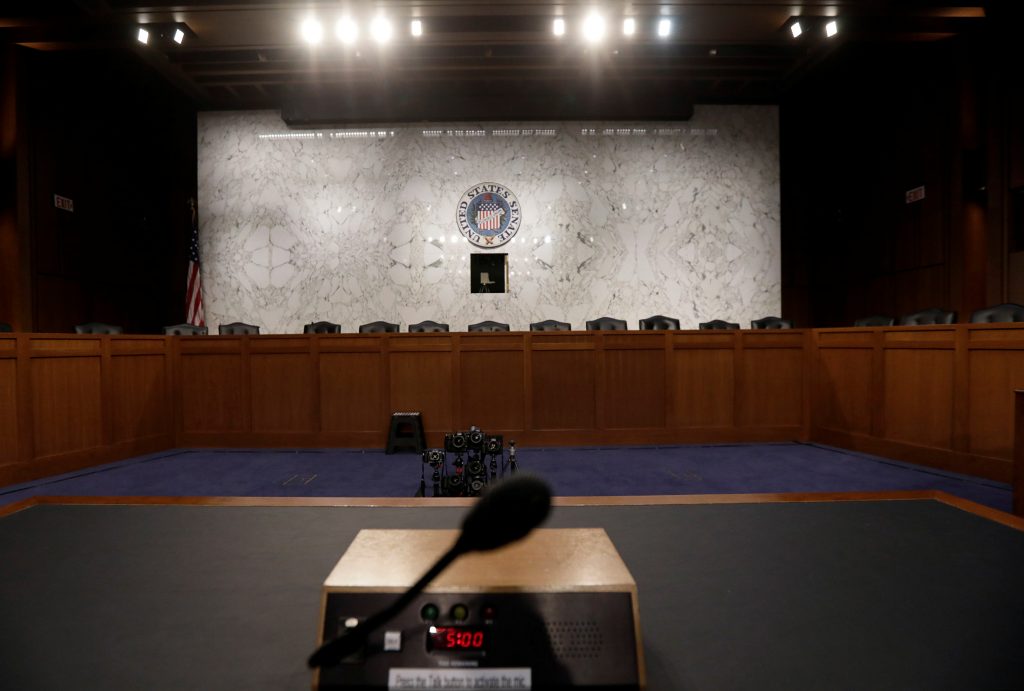
Senate hearing witness table, source: Jim Bourg/Reuters
ChatGPT 5.6 has been out for a few weeks and minus the usual new model hysteria, reception is mixed. Vibe coders have managed to have their usual fun though. After one OpenAI intern demonstrated their agent-assisted works, Sam Altman, known for his 2014-19 tenure as Y Combinator president, noted that the outfit maker tool “would have been a whole startup not too long ago”.
It is rare to see a tech disrupter acknowledge their impact on an entire market in such flippant manner, and a full circle moment. Altman has been present and active in the two of the most impactful tech business revolutions of the past 20 years, being a member of Y Combinator’s inaugural cohort in the startup boom, and now pulling strings behind the modern AI-backed wave.
Today, the opportunity to build and scale a tech startup is available not just to Stanford dropouts, but anyone with an idea and enough money to pay for the compute. The future envisioned is one of a tech industry without technical barriers, where to know a hash function from a hashtag is to be overqualified, and, the best part, where you will never have to put up with another software developer again. Unfortunately, this utopia remains distant, one reason being that it costs too much. A scarcity problem has slowly emerged, and usage limits are hitting everyone from your local AI B2B SAAS to the blue chips.
Another reason is that frontier models are being gatekept. The American models, at least. The latest flagship model of Claude, Mythos 5, has been kept well in the vault after Anthropic warned the world it was too dangerous for a public release. We do now have full access to Fable 5, essentially Mythos with stringent safeguards, and saw the full release of the new Opus 5, days after the release of competitor open-weight model Kimi K3 by China’s Moonshot AI, who were once again slapped with allegations of illegal distillation – i.e., using Fable’s output to train Kimi.
The incredible recovery of Chinese models in the AI race, despite strict controls on US hardware (e.g. NVIDIA GPUs) and LLM exports, points to some takeaways. Fundamental limits (energy, hardware, training data, money) are pushing Western engineers away from the scaling law mantra and instead towards a focus on improving inference, reasoning, and machine “thinking”. It is paying off incrementally, with tests appearing to indicate Chinese models, such as Kimi K3, being more “token-hungry” than its top competitors. Despite this slender lead, frontier lab lobbyists have driven heavily for legislation to help push forward AI development faster than foreign competitors. This, of course, is not dissonant with Sam Altman publicly supporting (but not signing) Jensen Huang’s letter supporting open-weight models.
Is Anthropic’s accusation a confession? The allegations come at a convenient time regarding intellectual property governance, and the kick was probably last Monday’s confirmation that they must pay $1.5bn to authors whose works were pirated to train Claude. This comes to around $3,000 a title. On Tuesday, Claude Cowork then released a new feature: “teach” your agent to do a task by sharing a screen recording of it. The good news for Anthropic is that this is completely legal and most likely already accounted for in the T&Cs you sign. It already logs your keystrokes, knows your API keys, and can sweep through your documents at its own liberty. What extra harm is a video?
Then you have SpaceXAI’s Grok, prev. autonymously MechaHitler, apparently just taking your files without asking anyway. It has seemingly been caught uploading entire repositories of code to its servers without express user permission. As evidenced, the problem with web scraping for training data is that eventually you run out of pages to scrape – every corner of web content and line of copyrighted online material has been exhausted. The next best thing is private content that users unknowingly give you complete access to. You do wonder where one draws the line between a helpful coding tool and a Trojan.
What to ask next is how much our AI companies owe the public, for model construction and their associated effects. And, given their use of public goods for closed-source, should that be their decision, or the government’s? Currently, matters of sovereignty are very clearly outweighing altruism. Social responsibility discussions will not confront AI CEOs until congressional hearings eons away. Intellectual property lawsuits will be settled with meagre payouts every now and then, and it may stand to reason that legislation regarding AI training and usage has deliberately been left as a grey area, as with the financial realities. Accountability, it seems, is secondary to winning the race. Forego the former, and worst case, everyone loses – but bow out of the latter, and worst case, the West lose.


Leave a Reply