I never completely agree with the position that technology is an extension of one’s self.
Rather, most today and forever performs an extension of societal preferences, functions, and necessities, such as work and communication.
That’s what makes how we use modern personal and interpersonal technologies, like phones, smartwatches, lifestyle apps, whatever, so interesting. It invites the classic chicken-egg question – has the tech enabled culture or has culture enabled the tech? Moreover, we must ask whether the tech has also disabled culture, and if so, irreparably? The cycle is a strange one. Ostensibly civilisation develops, living standards get better, and society marches on, but the concession on the part of the individual is usually omitted from these discussions. The tech we use has exploited the collective biases and features of our society to mould the end-user and, in turn, individual expressions too.
Chic
Would you buy an ugly piece of technology in 2025?
There’s an inherent beauty in functionality, yet still, a pretty privilege applies. The benchmark has shifted and it’s now an expectation that the latest devices have a healthy symmetry, lack roughness, and present no casual imperfections. Companies cannot take the design risks they were 20, even 10 years ago, because ugly technology never wins long-term. And so the Kindle got sleeker. Gaming laptops had to go minimalist. Even Craigslist looks pretty clean nowadays. We have been conditioned on what to expect, by them, because our demand for beauty exposes aesthetic preferences that have persisted for millennia, i.e. Aristotle’s ID of beauty as order, proportion, and definiteness, the patriarch of Western design aesthetics.
Sometimes even the big organisations forget this, and failure ensues. Google blew a decade’s lead on smart-glasses not due to lack of features or unreliability, but because people didn’t feel like wearing what looked like an abandoned spy-tech project. (Plus, to be fair, the privacy issues.) Holistically, their product lacked an order and completeness consumers expected, and so it couldn’t, and didn’t, conform to the mainstream. If you look hard enough, you might be able to find the Google Glass in some hyper-technical manufacturing plants and factories, but not at Paris Fashion Week, or in a theme park, or on someone walking past you on the street.
Doing things well tends to pay better than doing things first. Meta’s Glasses have taken the lead in a long-quiet market, by nailing the aesthetics through collaborations such as those with the Ray-Ban and Oakley brands, but additionally, creating an intrigue only possible with a bit of notoriety.
Charisma
Breakthrough technology is not quiet or slow. To give an extreme example, ChatGPT required no longer than a business week to hit one million users.
While the Meta Glasses were unable to recreate this incredible uptake, another medium has been able to spotlight them. There are thousands of people who would not know what the Meta Glasses were had it not been for the nascent genre of TikTok & Instagram POV pranksters and pick-up artists. Unsurprisingly, you cannot scroll through a video’s comments without finding a reply rightly questioning the ethics of this content. Yet in the world of technology, virtually all publicity is good publicity. And every consumer wants a meaningful connection with the tech they use. Meta is just offering one.
Take sociologist and clinical psychologist Sherry Turkle’s words to the Harvard Business Review in 2003:
‘Social critic Christopher Lasch wrote that we live in a “culture of narcissism.” The narcissist’s classic problem involves loneliness and fear of intimacy. From that point of view, in the computer we have created a very powerful object, an object that offers the illusion of companionship without the demands of intimacy, an object that allows you to be a loner and yet never be alone. In this sense, computers add a new dimension to the power of the traditional teddy bear or security blanket.’
What ways may your computer, smart glasses, or generic technological device attempt to offer this 22 years later? In today’s age, consumers are often hyper-aware of the negatives of overconsumption, and those with a well-restrained interest in tech probably don’t need to worry about falling in love with their laptop. It is thus extremely important for market-leading tech to build an in-cultural vogue about itself, nothing too addictive, but something that makes one feel like they could be missing out. Something like the AirPods memes, exclusive owners’ clubs such as Samsung’s or Tesla’s (real companionship), Meta Glasses clips ranging from the wholesome to wholly scandalous.
Lexicon
The ultimate step to tech primacy is becoming synonymous with your product’s field. A very select few products might even ascend to the legendary plane of verbification, if enough have Googled, Skyped, or Photoshopped with you, to cement lasting cultural capital. As one Facebook user lamented on the shutdown of Skype, ‘what shall we say now “teams me?”‘
Language extends our familiarity with the product. Sentence by sentence, it makes the option that tiny bit more comfortable, and presents the safe exclusion of other possibilities. When was the last time someone told you to Google something and you thought “Let me use Bing instead, actually”?
Back to the intro. Technology’s impact on society is greatest when it squares (boxes? pixelates?) the circle of our individual quirks and choices, and by doing so, it abstracts human actions to repeatable and reproducible desires and necessities. The features presented here are just three examples of how, in the context of the personal and interpersonal, technology maps how we interact with and interpret the world. When the roads are built, and the routes are printed, the trails we abandon will soon fade, but the new streets will offer guide to discover further means of technological expression. Maybe tech hasn’t extended the self. At the very least though, it collectivises us.
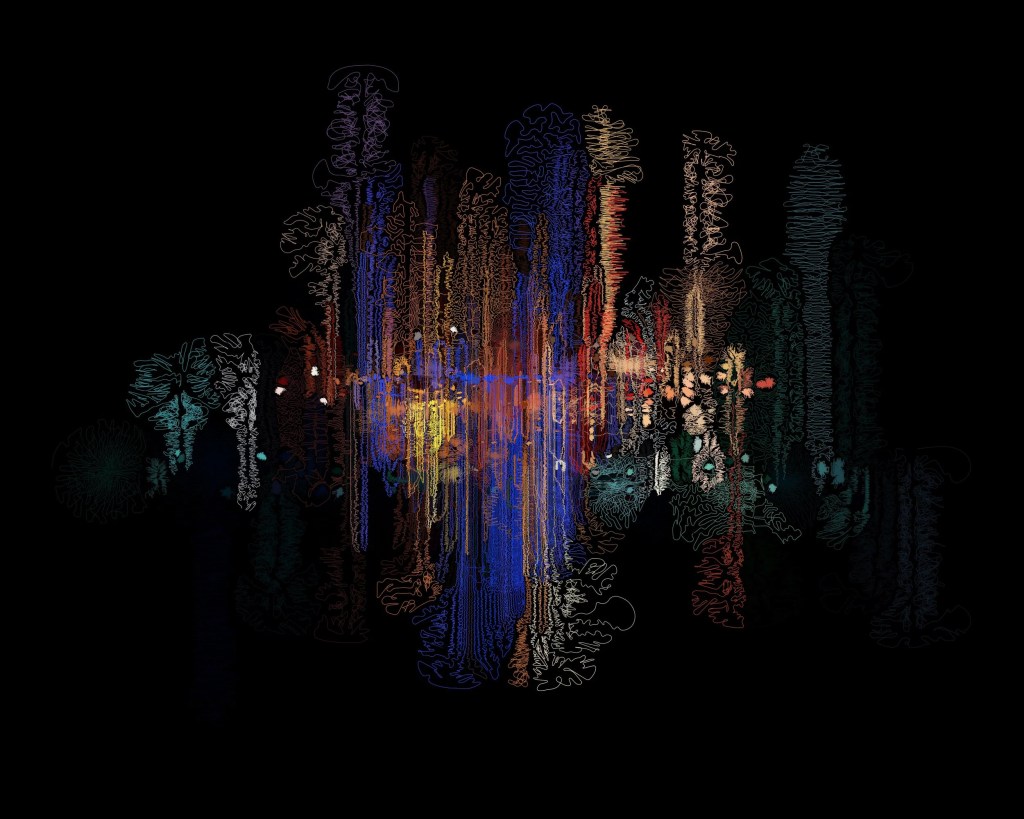
Espen Kluge’s Lyrical Convergance #38 (2022), source: https://www.espen.xyz/lyrical-convergence
 ThoughtBox
Leave a comment