They’re calling it the most successful sports tournament of all time.
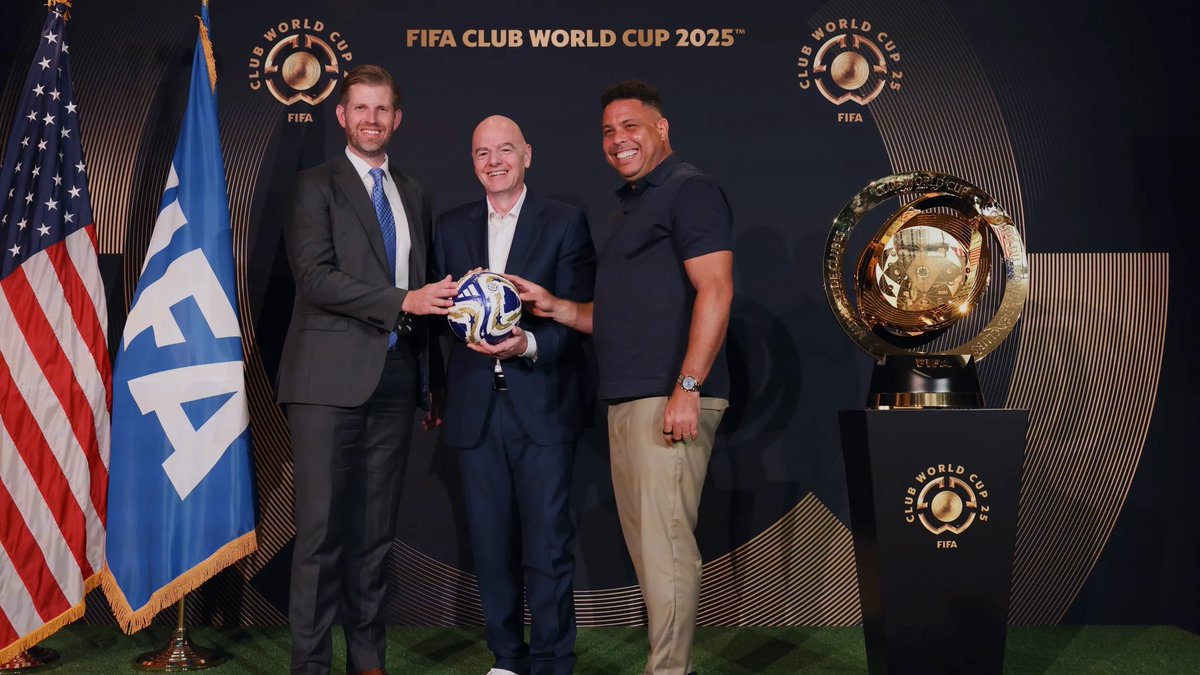
From left to right: Eric Trump, Executive VP of the Trump Organisation; FIFA President Gianni Infantino; legendary former striker Ronaldo Nazario de Lima; and the Club World Cup trophy at the new FIFA office in Trump Tower, New York City.
Professional sport is never a perfect microcosm for the world we live in, but it’s as good as one you’re going to get.
What could then be more anthropologically and economically interesting than a $1 billion football tournament, backdropped by the turbulence of the United States, governed by a sports body seemingly incapable of avoiding controversy in their behest of cash “truly global” football? World football’s governing body, FIFA, bankrolled by the likes of Bank of America and the Saudi Public Investment Fund, appear to have cracked it, warts and all.
We must not forget there is also $250 million apparently going to non-participant football clubs and organisations across the globe, aiming to reach thousands with the sport and bring it to new markets, build footballing infrastructure, and make football development more equitable for those with less access to it. Noble cause. However, this summer, the most thought-provoking equity lessons were taught in boardrooms across the States, Trump Tower conference rooms, and Zurich offices. Let’s explore.
Sporting Equity: The pendulum is often golden
It took just $480 million worth of transfers for an Asian team (Al-Hilal of Saudi Arabia) to defeat a European team (England’s Manchester City) in a competitive football match for the first time ever.
Global football talent’s distribution is far from uniform, and it only ever seems to be money that can smooth the density. 10 of Europe’s 12 representatives were included in Deloitte’s 2025 Football Money League, the top 30 clubs for revenue. The only non-European club on the list, Flamengo of Brazil, were also at the tournament. Backed heavily by the Saudi government’s Public Investment Fund and unshackled by the sustainable finance mandates better known in Europe and America, Al-Hilal entered with the dream of taking their brand global. Spending was the great leveller between them and Man City. Hunger was the tiebreaker. It’s a trick question to ask which way the pendulum swings, but more interesting is to ask when it is golden for one team.
Competitively, this was the biggest shock we saw. Sadly, incredible results like Brazil’s Botafogo defeating Champions League holders PSG mattered little (they both qualified from the group anyway). The tournament struck a perfect balance between global inclusivity and the assertion of Europe’s inevitable dominance. Almost nobody looked awfully out of place, but such was the perceived futility of this competition, Western media coverage of the tournament was disappointingly sparse as if inspired by some unspoken conscientious objection.

Todd Boehly (Chelsea FC chairman and shareholder, and investor) and Mark Walter (CEO of Guggenheim Partners, board member and shareholder of Chelsea FC, and majority shareholder of the Los Angeles Lakers) lift the Club World Cup trophy.
Financial Equity: Billionaires win again
Amidst the noise of player welfare concerns, the EAFC-style camera angles, and the melodramatic pre-match announcers, at least there were big winners.
It’s hard to see past the fact that the club owners were the real eaters from the tournament. The honeypot, an alien-tech-looking trophy and $100m for the winners, was more than enough to convince competing clubs to send their best and brightest playing staff for a month’s overtime work trip in the United States. This is not a bad showing for a World Cup new continuously tarred as another reckless impulse of FIFA’s avarice.
On the final’s eve, giving the keynote in Trump Tower, Gianni Infantino, FIFA President, called it the “most successful club competition in the world”. His logic? An average of $33m generated a match. Fair enough mate, I’m sure the accountants loved the football just as much as the fans did.
Chelsea chairman Todd Boehly will be delighted that in just three years since his takeover, four managers later, and after signing 60 new footballers, they possess the new crown jewel of club football. Meanwhile, his consortium of private equity (PE) investors will be similarly happy to see their £4.25b investment taking home big revenues.
Meanwhile, runners-up Paris Saint-Germain, famously controlled by the Qatari sovereign wealth fund, are less famously minority-owned by a PE firm. Man City, Internazionale, Juventus, Inter Miami, and Benfica also have PE minority shareholders. The other nine teams that reached the knockout stage are either majority fan-owned, or state-owned.
Elite professional sports, not just football, are the new instruments of choice for PE investors looking to make long-term returns. The NFL’s long resistance against it is fading. In basketball, the LA Lakers’ majority shares were recently sold to Mark Walter for $10 billion, the largest ever deal for a sports team. Yet as Alex Kirchner stated, the biggest sports teams are quickly becoming “too valuable an asset class” for even the regular billionaires. And thus, to satisfy the new clientele, the returns and rewards must increase commensurately.
Since the European elite’s sensational climbdown from the Super League project, UEFA (Europe’s football governors) and FIFA have left no stone unturned in their attempts to appease the rebel clubs, while quietly taking the opportunity to line their pockets. After UEFA’s ferocious, yet illegal, shutdown of the breakaway project, they decided to revamp the Champions League format into an eerily similar format, and in doing so:
- debasing the usual tension
- increasing the number of “big” yet functionally meaningless games
- giving us gamblers’ paradise on league gameweek 8
- making it near-impossible for any big teams to not qualify for the knockouts, worth about £30m.
The evergreen FIFA saw another idea. Infantino had floated the concept of a bigger Club World Cup a while back, first with 24 teams. Everyone hated it, and luckily for the clubs, the pandemic curtailed it. Next came a 32-team proposal. Everyone hated that too. Finally came the same proposal but with Super League-level cash on top. Heads turned.
As mentioned previously, Infantino asserted that this tournament’s “unprecedented solidarity investment programme” is aimed at developing football globally. Naturally, this aligns with the remaining prize money distribution, where European clubs earn up to four times as much per game as a club from Africa or Asia, and up to 12 times more than a club from Oceania. While common sense would correctly posit that giving weaker teams equal sums would probably render their continent’s football uncompetitive for many decades, (Auckland City, Oceania’s 2025 representative, are only semi-professional) this does result in some interesting consequences for Europe, because the semi-closed format is the ingenuity here.
Europe currently have just enough slots to cover CL winners and eight other top-ranking teams. Football’s landscape shifts like tectonic plates; sudden snaps and earthquakes are rare, but you feel minor tremors from time to time. As such, changes at the top take time but still happen, sometimes abruptly – even Manchester United’s decade of humiliation wouldn’t have convinced anybody to bet on them finishing 15th in the Premier League last season.
For clubs with management more prescient than Man Utd’s, quadrennial stimulus packages could be enough in cash and reputation to subdue the slide at a shrewd club confronting decline. Thus, the elites can still eat healthily, provided they outperform their compatriots and reach enough Champions League quarterfinals.
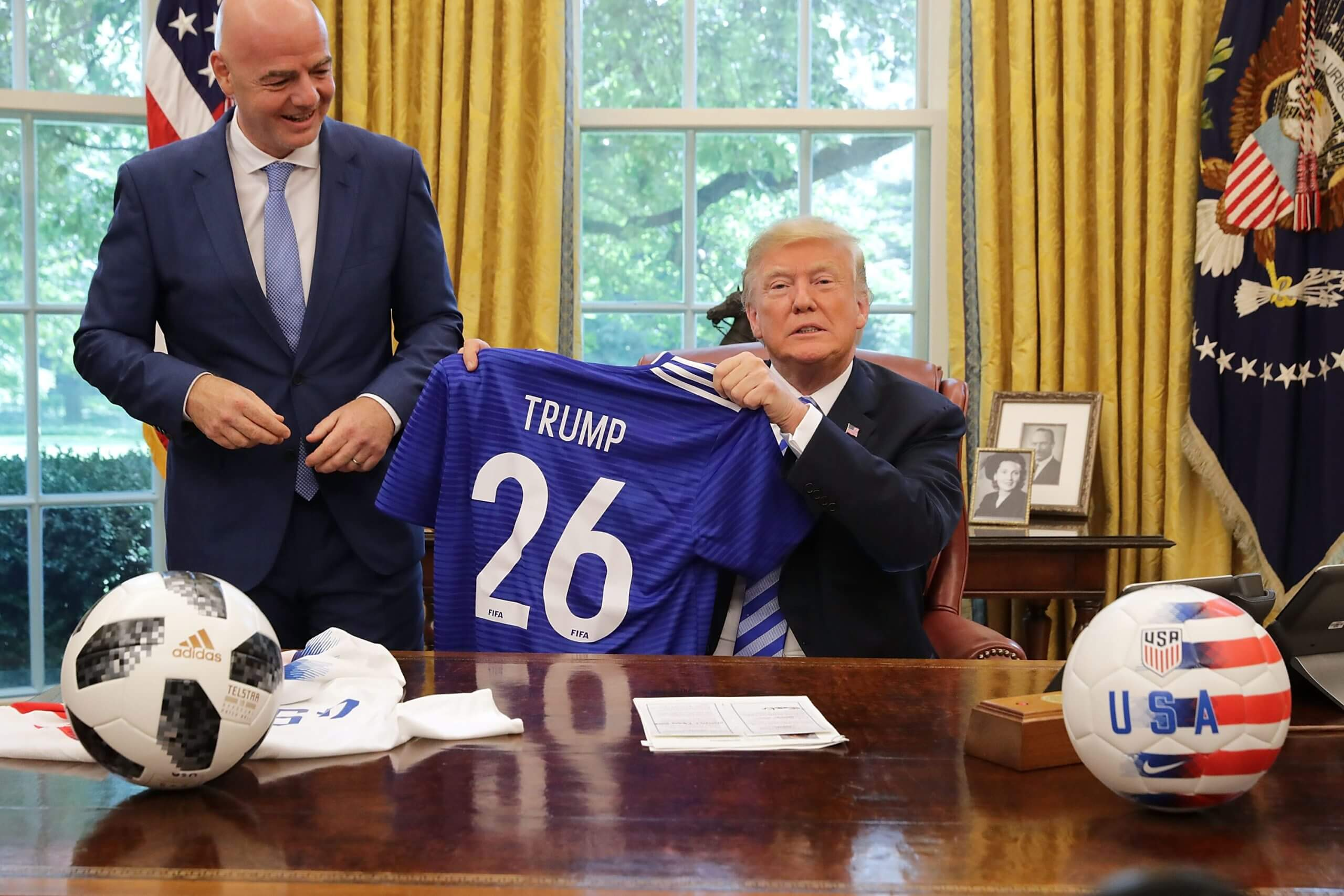
Gianni Infantino with US President Donald Trump at the White House earlier in 2025. The 2026 Men’s World Cup is also taking place in the United States, co-hosting with Canada and Mexico.
Could we see a biennial tournament? FIFA are cold on it, but Real Madrid want one already, and if the clubs are onside, you’ve all but scored. Internally, FIFA are already having serious discussions about the feasibility of a 48-team tournament. We didn’t see Barcelona, Liverpool, Milan, Man Utd, and many other top teams at this tournament. We may see them in the next edition even if they don’t play any better. After all, the top teams playing each other, all the time, every season, is always lovely, right?
Final thought. This tournament was an entirely selfish act. Gianni Infantino yearns for a legacy, and is leveraging every tool at his disposal to forge one. From boys’ trips with President Trump to the bureaucratic artistry that delivered 2034 World Cup hosting rights to Saudi Arabia, he is making friends larger than life, and this hubristic venture is just one leaf out of their political playbooks. He has also learnt the very important lesson of what to do if it’s not the right time or place for an idea: just mould your environment to satisfy both.
A note to Gianni. Expansion is not always growth. Bigger is not always better. He knows better than anyone on the governing committee that when you throw money in a realm as top-heavy as football, it is usually caught by the rich. Best case, trickle-down economics does its thing (haha). Worst case, the super-rich cluster to dictate the game, not in open house, but behind closed doors. But maybe, just maybe, that is the plan.

Chelsea captain Reece James waits (without reward) for President Trump to leave the stage before lifting the trophy after their 3-0 win vs Paris in the final. Get used to seeing politicians in your sportscasts.
 ThoughtBox
Leave a comment